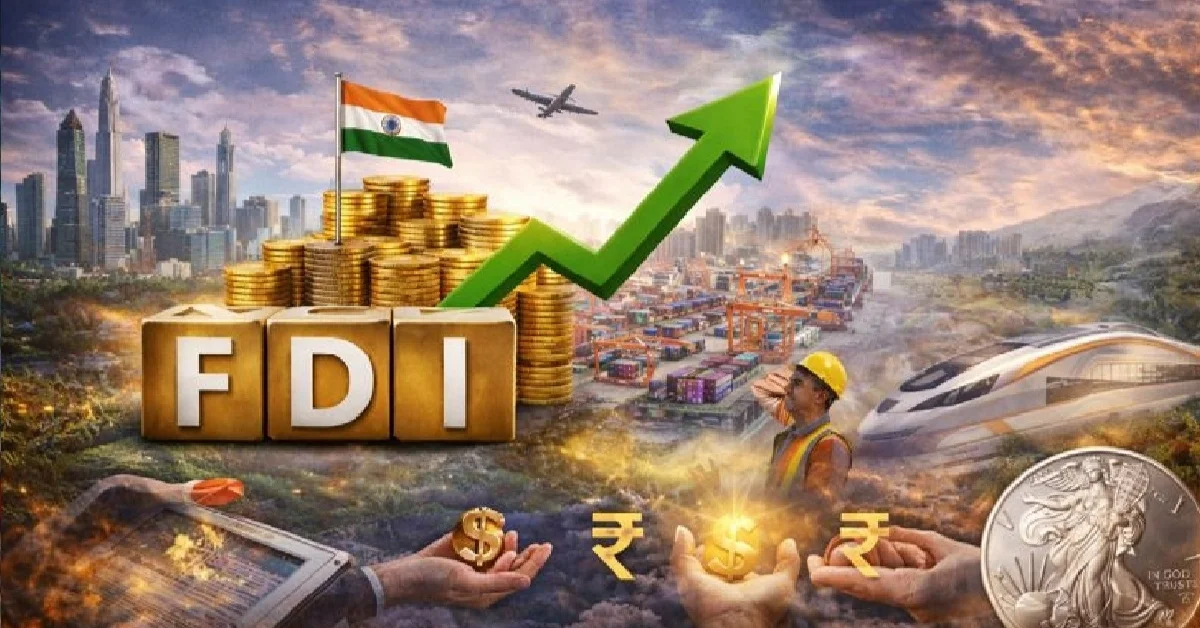
FDI: When ordinary citizens see better roads, faster trains, and modern airports, they feel a sense of convenience. Meanwhile, foreign investors see future profits in these very same changes.
The rapid expansion of infrastructure in India has completely transformed the country’s image. India is now seen not just as a developing nation, but as a strong investment hub.

Why 2026 is considered a crucial year
Experts believe that 2026 could be a major turning point for India in terms of FDI. This is due to continuously growing investor confidence, stable economic policies, and the government’s clear intentions.

The foundation laid in recent years will show its true impact in the coming years, and India will become even stronger on the investment map.
| Aspect | Key Details |
|---|---|
| Main Topic | India Emerging as a Major FDI Hub by 2026 |
| Driving Factor | Rapid Infrastructure Development |
| Key Infrastructure Areas | Roads, Railways, Ports, Airports, Digital Networks |
| Government Role | Continuous FDI Policy Reforms and Simplification |
| Approval Process | Faster Clearances Through Online and Single-Window Systems |
| Department Involved | DPIIT (Department for Promotion of Industry and Internal Trade) |
| Recent Performance | Record FDI Inflows in FY 2024–25 |
| High-Growth Sectors | Manufacturing, Green Energy, Digital Technology, Startups |
| Investor Confidence | Boosted by Policy Stability and Ease of Doing Business |
| Future Outlook | Strong Possibility of New FDI Records in 2026 |
Roads, railways, and ports: the backbone of investment
Expressways, modern railway corridors, and upgraded ports across the country have facilitated trade. Freight costs have decreased, and transit times have been reduced. This is a major signal to foreign companies that India is now fully prepared for large-scale production and exports. This confidence is driving increased FDI.

Digital infrastructure boosts global confidence
The Digital India campaign has made India technologically advanced. High-speed internet, online payments, and digital governance have simplified business operations.
Foreign investors now see significant opportunities in digital services and technology-based industries in India. This digital strength sets India apart from other countries.
Continuous improvements in FDI policy
The government has made the FDI policy more practical and investor-friendly over time. Regulations have been simplified in several sectors to ensure that foreign companies do not face unnecessary hurdles. Transparency and stability in the policy have given investors the confidence that India is a safe long-term option.

Faster approval processes transform the experience
Previously, investment proposals took months to get approved; now, the process is completed within a stipulated timeframe. Online systems and single-window clearances have streamlined the process.
This is a significant change for foreign investors, as both time and clarity play a crucial role in any investment decision. DPIIT’s Proactive and Decisive Role
Record FDI Boosts Confidence
The record level of FDI in FY 2024-25 is proof that India is moving in the right direction. This figure not only reflects capital inflow but also portrays a picture of global confidence. The government expects this record to be broken again in 2026, setting new benchmarks.
Foreign Interest in New Sectors
Today, FDI is not limited to traditional industries. Foreign companies are investing freely in sectors like green energy, manufacturing, startups, and digital technologies. This is creating new employment opportunities and bringing modern technology to the country, strengthening India’s competitive edge.

India Strengthened by Global Partnerships
New trade agreements and international collaborations are making India a key part of the global supply chain. Major global companies are viewing India as a long-term partner. A stable democratic framework and a clear vision for the future have further deepened this trust, which is crucial for FDI.
Self-Reliant India Moving Towards the Future

The infrastructure boom, policy reforms, and ease of doing business have together given a new direction to India’s investment future. India becoming an FDI hotspot by 2026 is not just an estimate, but a goal based on solid foundations. This transformation will prove to be a major step towards making India economically strong and self-reliant.
FAQ
Q1. Why is India expected to become an FDI hub by 2026?
Strong infrastructure, policy reforms, fast approvals attract global investors consistently.

Q2. How does infrastructure growth support foreign investment?
Improved transport and digital networks reduce costs, boost investor confidence.
Q3. What steps has the government taken to increase FDI?
Government simplifies FDI rules, ensures transparency, stability, and faster clearances.
Q4. Which sectors are receiving the highest foreign investments?
Manufacturing, green energy, infrastructure, startups, and technology receive maximum investments.

Q5. Is India a safe long-term destination for foreign investors?
Yes, stable policies and infrastructure make India reliable long-term destination.
Disclaimer: This article is based on general information and publicly available facts. Before making any investment decisions, please consult a financial or economic expert.
Also read:
Income Tax Refund Status Live: Revised ITR Deadline Extension Explained
New Income Tax Act 2026 Explained: Tax-Free Income Up to ₹12 Lakh, Key Changes and Impact
IDBI Bank Privatization Update: Strategic Sale Likely by March 2026