RBI Proposes One Hour Delay: In the modern world of hurry and rush, money transfer has become just as easy as transfer of a message. It could be remitting money to the shopkeeper, settling a bill with a friend, or sending money to relatives, but digital payments have become a normal aspect of life.
But such ease has brought with it an increasing danger. Increasing numbers of people are becoming victims of online scams and the amount of money lost is not minor any longer.
As a solution to this growing alarm, the Reserve Bank of India is now considering an innovation that would transform the instant payment process in India.

RBI Proposes One Hour Delay
| Feature / Rule | Details |
|---|---|
| Proposed By | Reserve Bank of India |
| Affected Systems | UPI and IMPS |
| Cooling-Off Period | 1-hour delay for transactions of ₹10,000 or more |
| Money Status During Delay | Amount deducted but held temporarily before reaching receiver |
| Cancellation Option | Users can cancel transaction within 1 hour if needed |
| Reason for Change | Rising cyber fraud and social engineering scams |
| Fraud Statistics | Cases increased from 2.6 lakh (2021) to 28 lakh (2025) |
| Total Money Lost | ₹22,931 crore |
| Kill Switch Feature | Option to instantly block all digital payments in case of suspicious activity |
| Extra Protection | Approval from trusted person for transactions above ₹50,000 (for elderly/disabled users) |
| Current Status | Proposal stage |
| Feedback Deadline | May 8 |
| Implementation | Final decision after review of feedback |
The reasons why RBI is interested in slowing down instant payments
Digital payment systems such as UPI and IMPS have increased over the last couple of years. The convenience is indisputable. But crooks have changed at the same rate.

The official statistics indicate a significant increase in the number of frauds, which have increased to almost 28 lakh in 2025 compared to approximately 2.6 lakh in 2021. The total money lost has crossed ₹22,931 crore. That’s not just a number. It is the depiction of real people who are losing their hard-earned savings.

Majority of these scams are based on panic. Fraudsters establish a sense of urgency and victims are pressured to send money as soon as possible before they can reason. This is what the RBI desires to shatter.
What Is the Proposed Cooling-Off Period
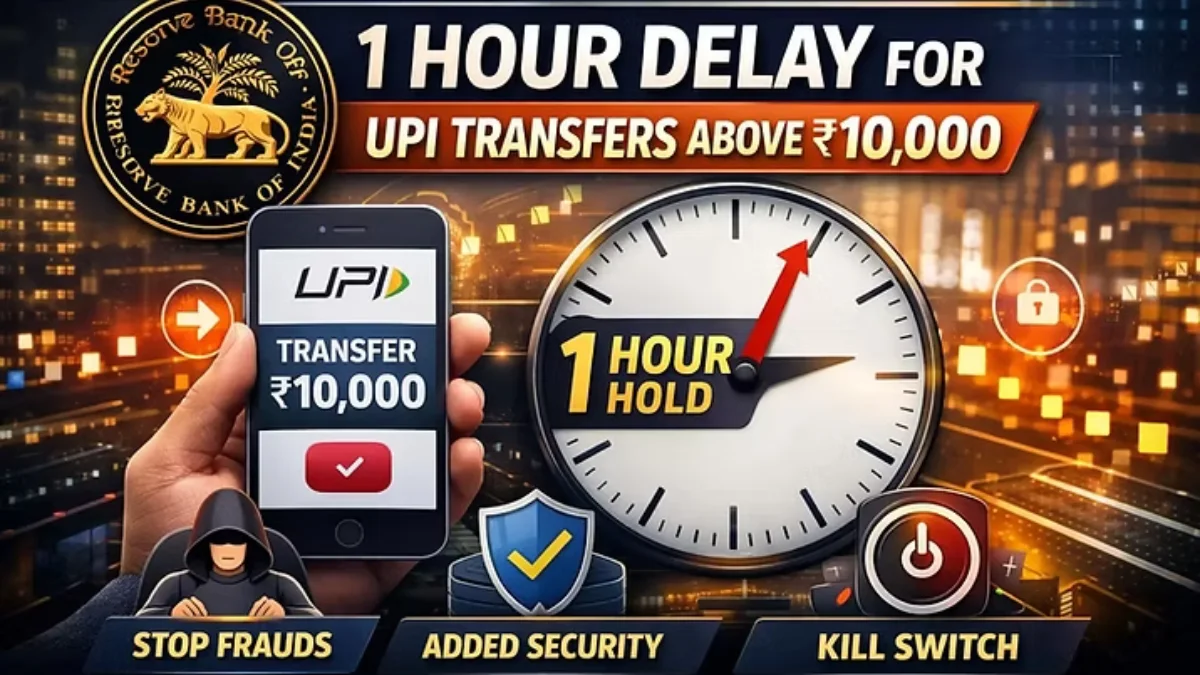
The RBI has suggested a “cooling-off period” for transactions of ₹10,000 or more. This implies that the money will not be transferred immediately.
Rather, after you start paying, the money will be taken out of your account but will wait up to one hour before it gets to the recipient. It is also in this time that you are capable of canceling the transaction since you might realize something is amiss.

It is a little break that might have a great impact. It allows individuals to take a step back, re-examine the situation and evade a trap.
How This Change Can Safeguard you
The idea behind this move is simple. Decisions are better when emotions are settled. A lot of fraud cases occur due to the pressure of people.
When given a window of one hour, users will be able to identify red flags, discuss it with a trusted person, or report suspicious behavior. This limit has been set thoughtfully since almost 98.5% of the loss through the transactions exceeding 10,000 rupees are the result of fraud.
Additional Safety Features can be implemented
The delay is not all that RBI is doing. It is also investigating other levels of protection to ensure safe digital payments.cOne of these is a “kill switch” feature. You may immediately block all the digital transactions in case you feel there is something suspicious in your account. This may serve as an emergency brake in case something feels wrong.

The other suggestion is on vulnerable users protection. In the case of older citizens or those who are not as tech-savvy, they should be allowed to transact beyond ₹50,000 with the consent of someone whom they trust. This may be the family member or the one they are relying on that provides an added security.
When Will These Rules Come Into Effect
At this moment, these changes are in the proposal phase. The RBI has requested banks, stakeholders, and the general mass to give their feedback. The last date of suggestions is May 8.
The central bank will determine the implementation of these rules and when after considering the responses. Therefore, nothing has changed yet but the trend is evident, safer online transactions with more time to reason.

What this implies to regular users
Initially, a lag in the instant payments would be inconveniencing. We are accustomed to hurry and it might take an hour to be impatient. But in the grand perspective, this hiatus is rather safeguard than restraint.

It’s a mere change of instant to intelligent payments. And during the period of time when fraud can be more and more sophisticated, an hour can make the difference between a person losing a lot of money.
Disclaimer: This article is founded on suggested rules and publicly accessible data. The last rules, the timeframe of implementation and features themselves can be modified once the Reserve Bank of India reviews them. Never rely on any unofficial updates or your bank on the latest and accurate updates.

Also read:
Build Big Retirement Corpus: Even on a Small Salary With Smart Saving Strategies
Realme Narzo 100 Lite Launch: Price Features 7000mAh Battery 144Hz Display India